Kansas leads the nation in severe weather events per year since 1990, and longtime Wichita meteorologist Rob Lawson says understanding the science behind the storms can help save lives.
Lawson, who has forecast weather in Wichita for 25 years and grew up in Omaha, delivered his “Storm Fury on the Plains” presentation Thursday, April 9, as part of a traveling presentation aimed at educating residents, law enforcement, and emergency officials. The sessions, held around 30 times a year, are open to the public, though many residents mistakenly believe they are only for first responders.
“The purpose is education,” Lawson said, noting he aims to blend meteorological science with practical safety advice. “We want to help people stay safe and protect their families.” Kansas averages 15 to 20 severe weather watches per year, Lawson said, second only to Oklahoma in total severe weather activity. Over the course of his career, tornado and severe thunderstorm watches have become smaller and more precise as forecasting technology has improved.
Lawson emphasized the difference between a watch and a warning: a watch means conditions are favorable for severe weather, while a warning indicates severe weather is occurring or imminent.
Wireless Emergency Alerts, or WEA, are triggered for tornado warnings, winds of 80 to 100 mph, baseball-sized hail or larger, and flash flooding. Less severe thunderstorm warnings do not trigger alerts unless they meet those higher thresholds.
In the past year, Neosho County saw an average of 1.4 tornado warnings and 35 severe thunderstorm warnings, a relatively quiet season, Lawson said.
Lawson explained that the average thunderstorm lasts about 30 minutes and described the updraft as the most important part of a storm. The stronger the updraft, the greater the chance for large hail.
He outlined several storm types: — Single-cell thunderstorms: Short-lived and disorganized, sometimes producing dime- to quarter-sized hail.
— Multi-cell clusters: Slow-moving storms that can bring heavy rain.
— Squall lines: Long, organized lines of storms stretching hundreds of miles, typically producing damaging straightline winds of 60 to 80 mph and occasional brief tornadoes.
In rare cases, squall lines form a “bow echo,” where the line bows outward, producing winds of 80 to 100 mph or higher. Shelf clouds — wedgeshaped, low-level clouds — often signal the presence of a squall line.
Supercells, Lawson said, are the most dangerous type of thunderstorm. Defined by a rotating updraft, supercells can last for hours and produce golf ball-sized hail or larger, downburst winds and tornadoes.
Not all supercells produce tornadoes, but most significant tornadoes come from supercells. About 95% of tornadoes are rated EF0 to EF2 on the Enhanced Fujita scale, while most fatalities occur in EF3 or stronger tornadoes.
He discussed tornado types, including rope, cone, and wedge tornadoes. Wedge tornadoes are particularly large and destructive, though they do not typically start at full width. Lawson cited the deadly 2011 Joplin tornado as a rare example of a tornado that rapidly intensified.
Landspout tornadoes, which form along slow-moving or stationary boundaries, can be difficult to detect on radar because of their small size. Though typically weaker, Lawson said there have been rare cases of EF3 landspouts, including one near Nickerson in July 2016.
A key ingredient for severe weather is wind shear — winds that change speed and direction with height. Favorable wind shear tilts the storm’s updraft, allowing rotation to develop and preventing rain-cooled downdrafts from choking off the storm.
Visible signs of strong storms include overshooting tops, which appear extremely cold on infrared satellite imagery, and wall clouds, a lowering beneath the rain-free base of a supercell. Shelf clouds, by contrast, typically stretch across the horizon and are associated with outflow from squall lines. Lawson cautioned residents not to confuse scud clouds — ragged, low-hanging clouds not attached to the storm base — with tornadoes.
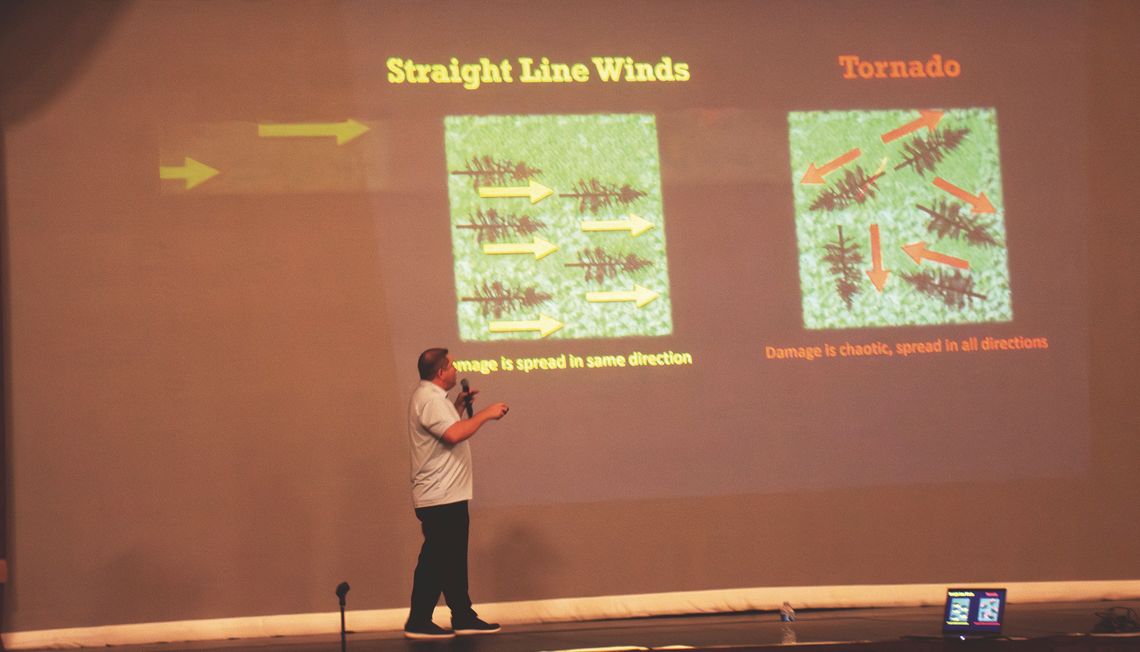
Microbursts, or downbursts, occur when a storm drops a concentrated column of rain and wind over a small area, often just a couple of miles wide. Damage can resemble that of a tornado, but debris patterns typically fall in straight lines rather than the rotational pattern associated with tornadoes.
Around the region, winds exceeding 75 mph are considered significant, Lawson said.
Lawson stressed situational awareness during severe weather. Residents should maintain good visibility, avoid being surrounded by storms, and always have an escape route. If caught in a vehicle during high winds, he advised pointing the vehicle into the wind to reduce the risk of rollover.
He also encouraged detailed public reporting during severe weather events, including time, location, hail size, and whether a tornado is still on the ground. The National Weather Service hotline accepts text reports, which Lawson said have proven valuable during major events.
Despite advances in radar, satellite, and model data, Lawson said forecasters still rely heavily on public reports.
“Even with all the cool stuff, we can’t see everything,” he said.
With Kansas’ long history of severe weather, Lawson said community education remains one of the most effective tools for reducing risk.
“These are open to everyone,” he said of the presentations. “The more people understand what they’re looking at, the safer they’ll be.”